Djerba · Houmt Souk
Houmt Souk is Djerba's beating heart. The island's historic capital, this former trading town has kept its colourful fishing harbour, its white and blue alleyways, its fondouks turned into charming hotels, and a souk that comes alive from the morning. This is where most of the island's heritage is concentrated, UNESCO World Heritage-listed since September 2023: an Ottoman fortress, a 19th-century Catholic church, living craft workshops, not to mention two beaches within walking distance of the town centre. Here is our complete guide to planning one or several days in Houmt Souk, between history, gastronomy and seaside.
Heritage and activities: following Houmt Souk's history
You can't miss Bordj Ghazi Mustapha (also called Borj El Kebir), the fortress overlooking the seafront since the 13th century. Built by the Ottomans on the foundations of a former Spanish fort, it withstood sieges and naval battles for control of the island. You climb it mainly for the view: the multicoloured fishing harbour and the bay, particularly beautiful at sunset. The interior holds former casemates and a small space devoted to Djerba's military history. Open from 9am to 5pm (closed Monday), entry costs around 5 dinars. The best time to visit is late afternoon, when the golden light illuminates the harbour and the souk, five minutes' walk away, comes alive with the fishermen's return.
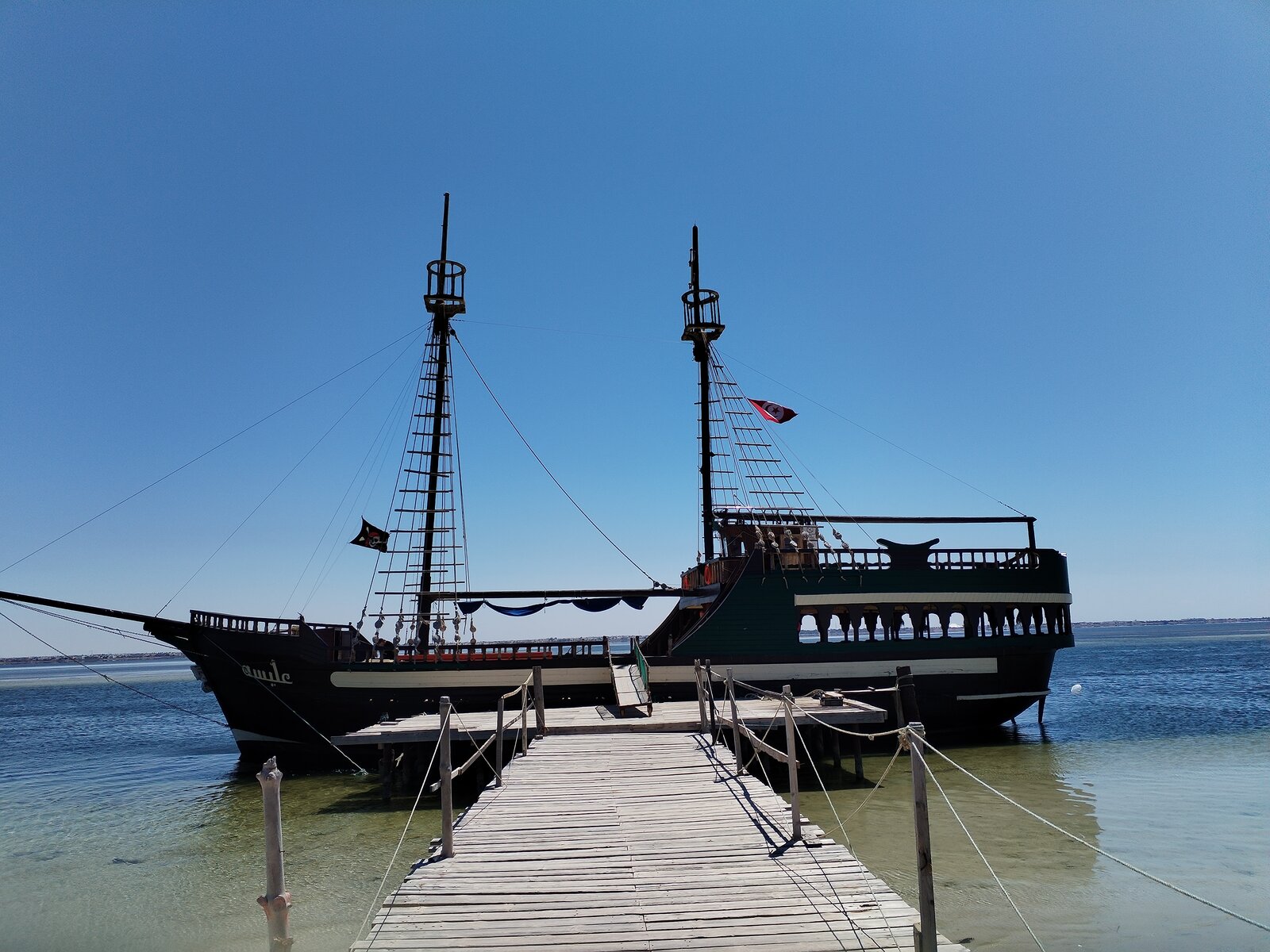
The pirate boat Elyssa, departing every morning towards Pink Flamingo Island
To head out to sea, make for Houmt Souk marina, where the Elyssa, one of the island's best-known pirate boats, is moored. Every morning (departing between 9 and 10am), it takes children and adults alike to Pink Flamingo Island, in a festive atmosphere driven by music and a costumed crew — with dolphins sometimes spotted along the way. On the programme: swimming, lazing on the sand and a traditional lunch (couscous, grilled fish, seafood) served under a beach shelter. Expect about 25 dinars booking directly with the boat rather than through a hotel, often pricier for the same trip. The flamingos themselves aren't guaranteed year-round: it's mainly the onboard atmosphere and the meal that make this half-day trip a success.
The heart of the medina is also home to still-living craftsmanship. At Galerie Fatma, set in a fondouk, you can watch artisans hand-weave mats, bags, baskets and hats from palm, reed and halfa grass — a technique passed down through generations, showcased by a staircase painted with a poem on Djerban identity. A little further on, on Rue du 9 Avril, facing the Catholic church, La Maison de l'Artisanat brings together everything woven on the island: rugs, kilims, margoums and foutas, made by local weavers sometimes seen at work on their looms as you cross the shop. Both addresses are worth more than a simple souvenir shop: they offer a genuine glimpse of Djerban craftsmanship, with no obligation to buy.
Another heritage curiosity in the town centre: Saint-Joseph Church, built in 1848 by the community of Italian and Maltese fishermen and merchants settled in Houmt Souk, then extended in 1855. Its history is eventful — handed over to the Tunisian state in 1964, it served as a study hall then a gym before regaining its religious function in 2005-2006, after restoration and redecoration with reproductions of ancient Christian mosaics. It now welcomes both Catholic and Protestant worshippers, a heritage rarity at the heart of a majority-Muslim medina. Access is free, but the building remains an active place of worship: better to visit on a weekday, during the day, rather than hope to catch a service.
The beaches of Houmt Souk
About ten kilometres north of town, Ras R'mel — nicknamed Pink Flamingo Island — is a long sandy peninsula listed as a Ramsar site, a wetland of international importance. It separates the sea from a lagoon frequented by numerous migratory birds, including the pink flamingos that gave it its name (mostly visible from October to March). Access is almost exclusively by pirate boat from Houmt Souk harbour, often with entertainment, swimming on the sandbank and lunch on board — expect about 20 euros per person for the excursion. It's a wild beach with no facilities on site: bring water and sun protection, and keep in mind the flamingos aren't guaranteed year-round.
Closer to the centre, just about 400 metres from Bordj Ghazi Mustapha, El Jazira beach enjoys an ideal spot to combine lazing about and visiting the medina without needing the car. Fine sand, calm water, and a noticeably more local, lively atmosphere than the large hotel zones further south, with cafés, ice-cream parlours and small seafront restaurants. It's the beach to favour if you're staying in the medina and just want a quick dip between visits, with the fort's silhouette overlooking the bay in the background — a lovely spot for an impromptu sunset at the end of the day.
Where to eat in Houmt Souk
On Place Hedi Chaker, right in the souk, Café Zaraâ stands out from afar thanks to its façade painted with pink flamingos and a little penguin — a look that playfully contrasts with the medina's white and blue tones. It's the only genuine traditional Moorish café in Houmt Souk: stop by for a mint tea, a coffee or a fresh orange juice with no added sugar, particularly welcome after a stroll in the heat. The atmosphere is simple and warm, on a terrace shaded by a blue-and-white striped awning — an easy break to slip in between two stalls.
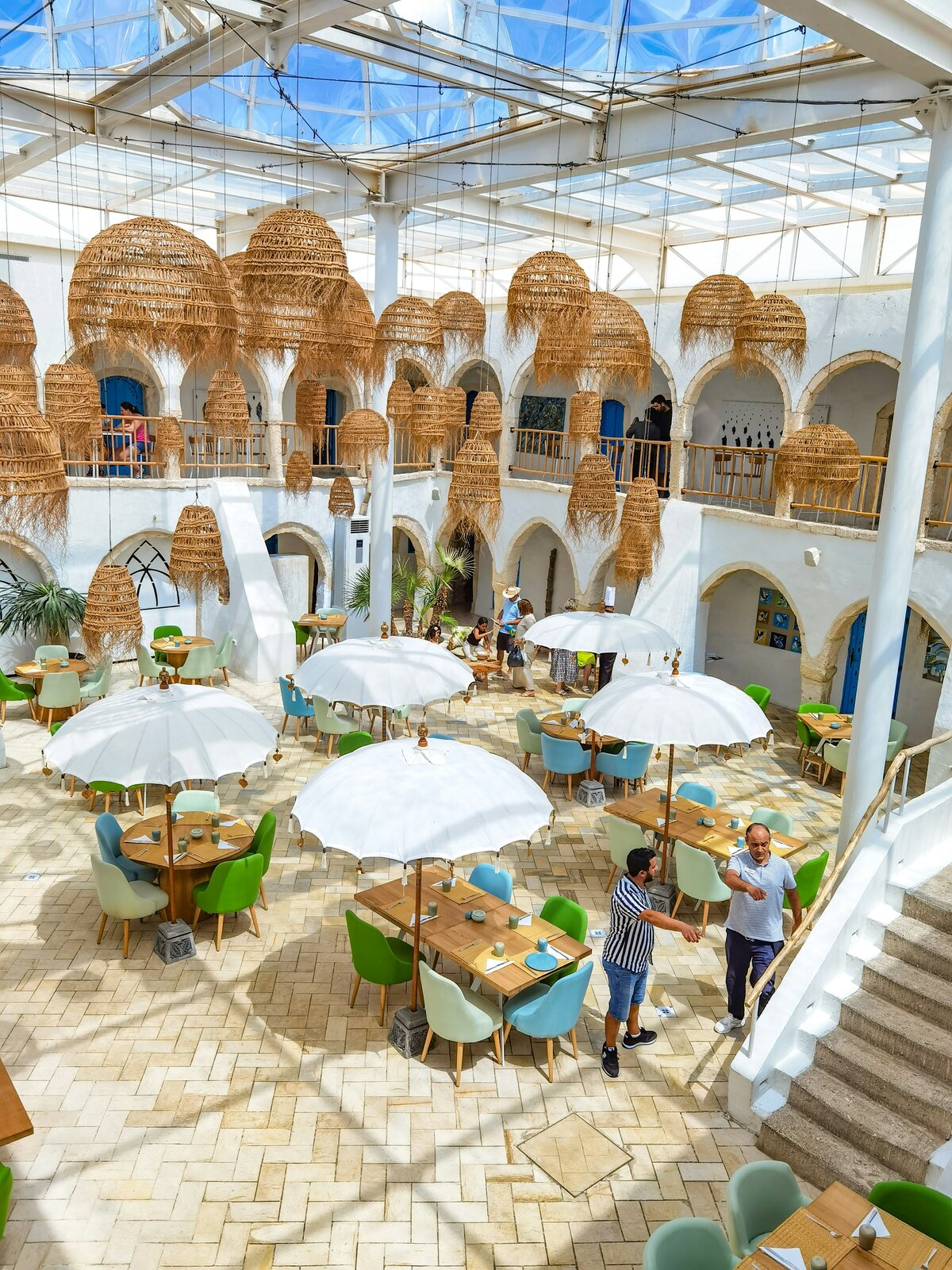
El Fondouk, a restored 18th-century caravanserai
At the entrance to the medina, El Fondouk occupies a restored 18th-century caravanserai, reopened in 2020 after eighteen months of work. The central patio, topped with a winter-garden-style glass roof and decorated with woven palm-fibre hangings, is a spectacular setting in its own right, busy from breakfast to evening. The cuisine blends traditional Tunisian dishes — Djerban rice, grilled fish — with more international menus, plus renowned pastries. The place also houses a modernised Tunisian craft concept store and an exhibition space upstairs. Expect a higher budget than the island average (around 70 to 140 dinars per person for a full meal), but even a simple coffee or pastry is worth the detour for the setting.
For a more affordable traditional meal, head to Bab Al Madina, a family restaurant tucked in the heart of Houmt Souk, two minutes' walk from the souk and the fort — whose view unfolds from its covered terrace. It serves the classics of Djerban cuisine: couscous, ojja, crispy briks, chorba, Djerban rice and catch of the day, in a warm, family atmosphere often praised by visitors (rated 4.5/5). Prices remain moderate, making it a good option for a terrace dinner after a day of sightseeing, with the silhouette of Bordj Ghazi Mustapha in the background.
Between Houmt Souk and the tourist zone, Yacht Club Djerba combines a tea room, restaurant and event space for private functions, in a seafront setting. It's mainly worth coming for the view and calm atmosphere, rather than for fast service — opinions are mixed on that point. An address to consider for tea or coffee facing the sea, or to hire out the space for a party or wedding.
Where to sleep in Houmt Souk
For a stay in the medina rather than Midoun's hotel zone, Hôtel Djerba Erriadh is a safe bet. Set in an old building with traditional Djerban architecture, it offers 26 rooms arranged around an inner courtyard planted with bougainvillea and aromatic plants. Simple and unpretentious (1-star category), it's an address valued for its calm, authenticity and excellent value for money (from around €45-50 a night, continental breakfast included), a few minutes' walk from the souk, cafés and Bordj Ghazi Mustapha.
Another address steeped in history: Hôtel Marhala, set in a former fondouk of the Tunisian Touring Club where merchants and pack animals once stopped over. Its 42 rooms are arranged around a large central courtyard, amid palm trees, bougainvillea, jasmine and an old cistern well; the ground-floor rooms once housed the merchants' stables. The atmosphere is simple and authentic, far from the large hotel complexes, steps from the souk and harbour. Expect between 40 and 65 dinars a night. A good base for exploring Houmt Souk on foot, less suited if the goal is to spend the day at the beach — better to stay closer to El Jazira or the Midoun area.
Also in the caravanserai style, Hôtel Arischa occupies a centuries-old fondouk, where Mediterranean merchants once stayed upstairs while the ground floor housed goods and pack animals. The rooms, redecorated with local crafts, are arranged around a patio where the old rainwater cistern has been turned into a small pool. The location is unbeatable: a pedestrian street in the heart of the old town, steps from the souk, a small church and the taxi stand. Expect around €70 a night depending on the season — a rate to confirm at time of booking.